UK heat pumps explained: costs, grants and the funding outlook
New-build rules in England and a squeeze on subsidy budgets are shaping the economics of heat pumps, which remain in fewer than 2% of UK homes.

Developers in England will have to fit heat pumps and solar panels to all new homes under regulations announced in March. The changes are estimated to add £10,000 to the price of a new home, although owners are likely to save on energy bills over the long term, according to the BBC, which first reported the details.
The push comes as the government tries to cut fossil fuel use. Heating homes accounts for about a fifth of the UK's planet-warming emissions, so replacing gas and oil systems is seen as central to meeting net zero targets.
In January the government introduced a £15bn Warm Homes Plan to help households pay for green technologies. The autumn budget then removed £1bn from the programme to fund defence spending.
How heat pumps work
Heat pumps run on electricity and are more efficient than conventional boilers. They absorb heat from the air, ground or water and raise its temperature to warm a building.
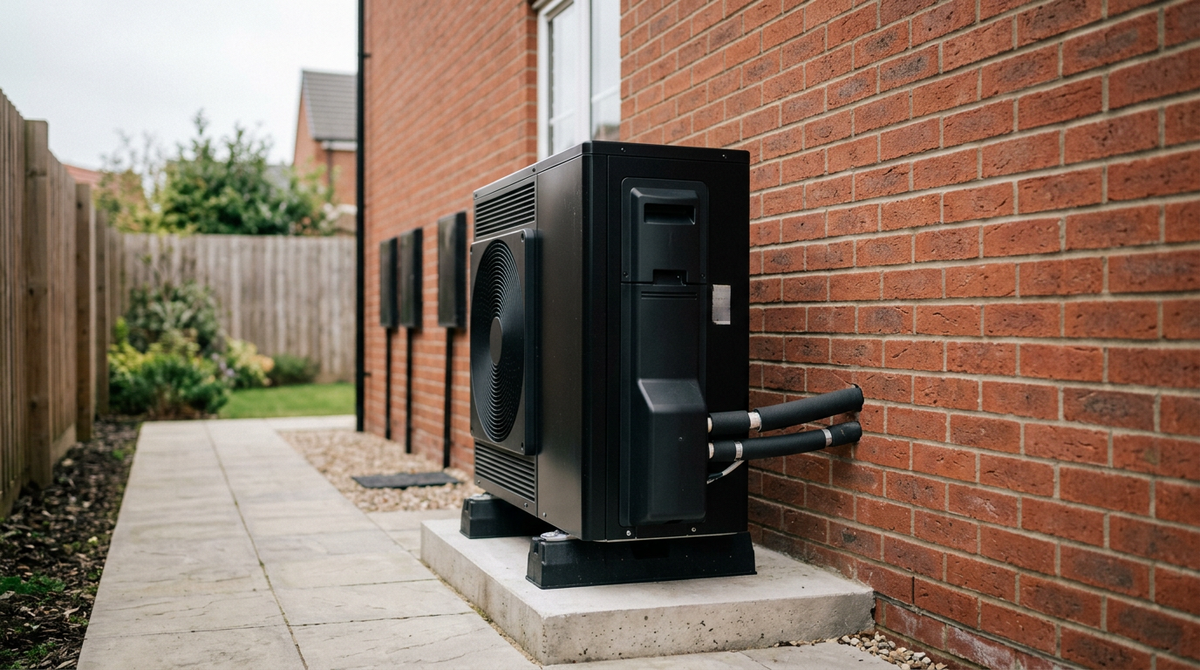
Air source units are the most common. They draw in outdoor air and pass it over tubes containing a refrigerant, which evaporates into a gas. Compressing that gas raises its temperature, and the heat is then circulated around the home.
A typical system has an outdoor unit of about 1m x 1m x 0.4m, plus an indoor unit and a hot water cylinder. The indoor unit is roughly the size of a gas boiler, while cylinder size depends on the property.
Ground source models are more efficient but usually cost more and are less widely used. They need either a deep borehole or a large horizontal network dug into the ground.
Costs and funding
The Boiler Upgrade Scheme offers £7,500 towards an air source or ground source heat pump for homeowners in England and Wales. Households typically pay about £5,000 on top of the grant. The UK's spending watchdog has warned that this is too high for many.
The grant covers existing homes and non-domestic buildings. The property needs an eligible Energy Performance Certificate issued within the last 10 years. Properties no longer need existing loft or cavity wall insulation to qualify, which can save around £2,500 in upfront costs.
Further support is available:
- The government is providing an extra £5bn for the Warm Homes Local Grant and the Social Housing Fund, aimed at low-income and social housing households.
- Scotland and Northern Ireland run separate efficiency schemes.
- Under the Warm Homes Loan Scheme, UK households can apply for low or no interest loans of between £7,500 and £35,000 for green technologies.
Subsidy outlook
The government has promised to hold Boiler Upgrade Scheme funding at £400m in 2027-28, then raise it in line with inflation. That is a significant reduction on what was previously announced.
Some of the money available to the energy and environment departments for loans and investments is also being redirected to the £4.7bn "Your First Home" scheme, which is intended to help people buy property. That could mean further cuts to the Warm Homes Scheme. The government says it "remains committed to heat-pump deployment".
Heat pump installations currently carry a 0% VAT rate. This is due to rise to 5% in April 2027.
Running costs
The Climate Change Committee, which advises the government on emissions, says heat pumps could become cheaper to run than gas boilers. Savings depend on energy prices and on how efficiently the system performs.
Heat pumps use around three to four times less energy than gas boilers, but electricity typically costs much more than gas. At present, electricity prices are largely set by gas prices in the UK and globally. The government expects that link to weaken as renewable generation expands. Removing VAT from electricity bills is also expected to bring a modest reduction.
Households that add solar panels could save more by generating their own power. Nesta, the innovation charity, estimates that the average home with both a heat pump and solar panels could cut its annual energy bill by nearly £1,000.
Noise and planning
Homeowners previously needed planning permission to install a heat pump within 1m of a neighbouring property because of noise concerns. That rule has been dropped to encourage uptake. Rules on the size and number of units a household can install have also been relaxed.
Newer devices are quieter and must operate below 42db, comparable to the noise from a fridge.
Deployment so far
More gas boilers than heat pumps are still installed in the UK, and heat pumps are found in fewer than 2% of homes. Installation rates trail those in France, Germany and Italy.
Sales have risen significantly in recent years, though there are concerns that progress is slowing.