Alinta Energy drops 7.2GWh Oven Mountain pumped hydro project in NSW
The developer cites economic and timing challenges, including a critical transmission line, as rising pumped hydro cost estimates and falling battery prices reshape Australia's storage pipeline.

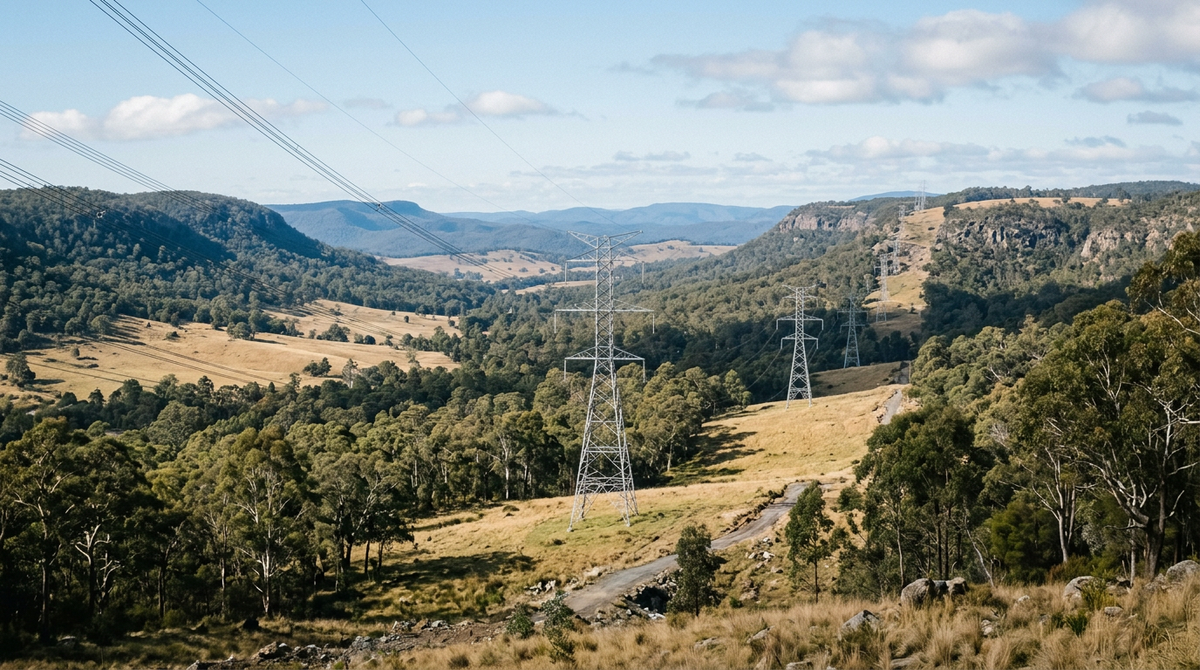
Alinta Energy has halted development of the 7.2GWh Oven Mountain pumped hydro energy storage (PHES) project in New South Wales (NSW), Australia.
In a notice on the project website, the generator and retailer said "economic and timing challenges on key elements of the project, including a critical transmission line, made it unviable to proceed." The notice does not identify the transmission line.
Alinta said the decision followed years of technical studies, planning, stakeholder engagement and development work. It said it had considered all available options before concluding the project was "no longer viable to progress."
Project background
Oven Mountain was planned as a 900MW, 8-hour project in the New England Renewable Energy Zone in northern NSW. It would have relied on new transmission upgrades to connect to the National Electricity Market (NEM), which serves Australia's eastern and southern states.
Water would have been pumped more than 600 metres uphill between reservoirs, then released through turbines when wind and solar output was low.
The NSW government declared the project Critical State Significant Infrastructure in October 2020, a planning classification for projects the state considers essential. It was then described as a 600MW/7,200MWh scheme.
At the time, then NSW energy minister Matt Kean said the Australian Energy Market Operator (AEMO) had found the state would need more than twice the storage capacity of Snowy 2.0 by the mid-2030s. He added that large pumped hydro projects can take about eight years to deliver.
In November 2024, Alinta signed an early contractor involvement agreement with a joint venture of Gamuda and Ferrovial. The arrangement drew on Gamuda's tunnelling and civil engineering experience and Ferrovial's record on hydro and dam projects. It was intended to advance design and constructability over about six months.
Construction was then expected to start in 2025, subject to approvals, with commercial operations slated for 2030.
Other NSW pumped hydro projects with the same status include the 2.2GW Snowy 2.0, the 3.6GWh Stratford Pumped Hydro and Solar project, and the 2GWh Muswellbrook and 2.6GWh Lake Lyell schemes.
Pumped hydro costs rise as batteries get cheaper
The decision follows an upward revision to pumped hydro costs in the final GenCost 2025-26 report from CSIRO, Australia's national science agency. Engineering consultancy GHD's updated assessment for the report drew on additional data from a current PHES development.
A 24-hour PHES system is now priced at AU$5,687/kW (US$3,991/kW) in 2025, equivalent to AU$237/kWh. CSIRO projects costs will rise through to 2055 as construction and land costs escalate, reaching AU$239 to AU$257/kWh. The report also notes that PHES carries a wider range of cost uncertainty than battery storage because of site-specific conditions.
Battery costs moved the other way. CSIRO reported falls of 11% to 16% in 2025, depending on duration. A 4-hour battery energy storage system costs AU$385/kWh, while a 24-hour system costs AU$266/kWh, just above the PHES figure. The 24-hour battery cost is projected to fall to AU$158 to AU$169/kWh by 2050.
Queensland projects under strain
In neighbouring Queensland, the state government has delayed the 2GW/48GWh Borumba PHES project, and its cost has risen. A December 2024 assessment found less than a 1% chance of first power by 2030 and pushed expected completion to around 2035. Borumba is now projected to cost AU$18.4 billion.
Earlier this year, the Queensland government shelved the AU$6 billion, 2GW/20GWh Mt Rawdon project after a review by the Queensland Investment Corporation. The scheme would have used the open-cut pit of a gold mine as its lower reservoir.
Evolution Mining and ICA Partners each held 50% of Mt Rawdon, which had received AU$50 million in funding from state-owned generator CleanCo. The state had previously scrapped the 5GW/120GWh Pioneer-Burdekin pumped hydro project.