Akaysha's Waratah Super Battery reaches final commercial operations
The 850MW NSW project has completed commissioning after a year of reduced capacity following a transformer failure. It now supports Transgrid's grid stability scheme while the Hunter Transmission Project is still to come.

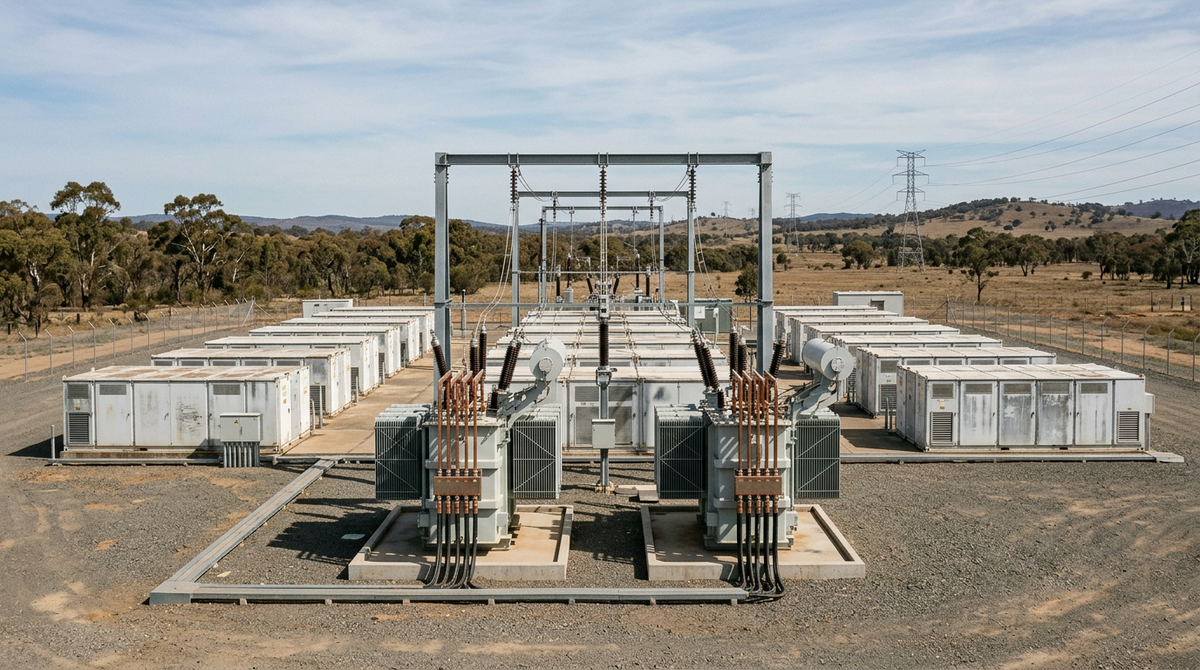
Akaysha Energy has brought the Waratah Super Battery to final commercial operations, completing a project that spent roughly a year running below its full capacity after a major transformer failure.
Akaysha said the battery and the System Integrity Protection Scheme (SIPS) are designed to help the grid respond quickly to disturbances. It described the pairing as a shock absorber for the network that supports the flow of more renewable energy across the transmission system.
"Bringing the Waratah Super Battery to final commercial operations is a landmark moment for Akaysha Energy, our project partners and most importantly, for NSW," said Akaysha CEO Nick Carter.
How the SIPS arrangement works
Under the SIPS arrangement, Transgrid can signal the battery to inject energy while instructing paired generators to adjust their output. The control system monitors 36 transmission lines in real time.
This allows existing lines serving the Hunter, Sydney and Illawarra regions to carry more power than they otherwise could. It is a stopgap until the Hunter Transmission Project connects inland Renewable Energy Zones (REZs).
Transgrid has contracted 700MW and 1,400MWh of guaranteed capacity from the project. Payments are adjusted through an annual process with the Australian Energy Regulator to reflect the service actually provided. That gives Waratah a revenue base that does not depend on trading spreads.
Akaysha said the project attracted more than AU$1 billion (US$690 million) in private investment. About 1,000 people worked on design and construction, including 170 on site at peak.
The company thanked EnergyCo, the NSW state-owned corporation that ran the procurement, as well as the NSW government, Transgrid and delivery partners Consolidated Power Projects Australia, Hitachi Energy, Wilson Transformer Company, REPT Battero and EVE Energy.
A year of reduced capacity
Waratah discharged its first full 850MW output to the National Electricity Market (NEM) on 10 October 2025. At the time, that was a record for a single battery storage discharge from NSW.
The same month, High Voltage Transformer 3 (HVT3) suffered a "catastrophic failure". HVT2 was taken offline as a precaution. That left the facility at 350MW, meeting only an interim SIPS obligation at that level.
Dr Tom Harries, partner at specialist battery storage insurance broker NARDAC, told Energy-Storage.news at the time that estimated total losses from the failure were AU$50-80 million. The figure depended on how quickly replacement transformers could be secured.
In February, Akaysha confirmed a third-quarter 2026 delivery timeline for the HVT3 replacement. Wilson Transformer Company manufactured it under its contract with Consolidated Power Projects Australia. Using a domestic manufacturer avoided the 12-18 month lead times typical of specialised transformers sourced overseas.
HVT2 returned first. In June, Waratah went back to 700MW and its full 1,680MWh energy capacity. 350MW was committed to the Transgrid SIPS contract and the other 350MW was available to trade in the NEM. Running at 350MW for most of the commissioning period left Akaysha receiving roughly half of its expected contracted revenue.
Earlier this month, Waratah briefly recorded its full 850MW output, then discharged 701MW two days later. According to Open Electricity data, that figure is consistent with its contracted 700MW SIPS obligation.
Supply chain changes
The project's supply chain also shifted during delivery. Original battery provider Powin filed for Chapter 11 bankruptcy protection, and Hitachi Energy took full ownership of Powin's power conversion partner, Eks Energy.
Akaysha's wider pipeline
Akaysha's other projects are also progressing. Its 311MW/1,244MWh Elaine BESS in Victoria has installed a second high-voltage transformer. The project is backed by AU$460 million in construction financing and a 15-year virtual toll, with Snowy Hydro covering 220MW.
In NSW, its 415MW/1,660MWh Orana BESS reached commercial operations in June within the Central-West Orana REZ.