Plug-in solar panels cleared for UK retail sale as government targets household savings
Rule changes allow plug-in solar kits to be sold in UK shops, offering a lower-cost route into solar power. Output is capped at 800W, and safety groups are urging buyers to check their wiring first.

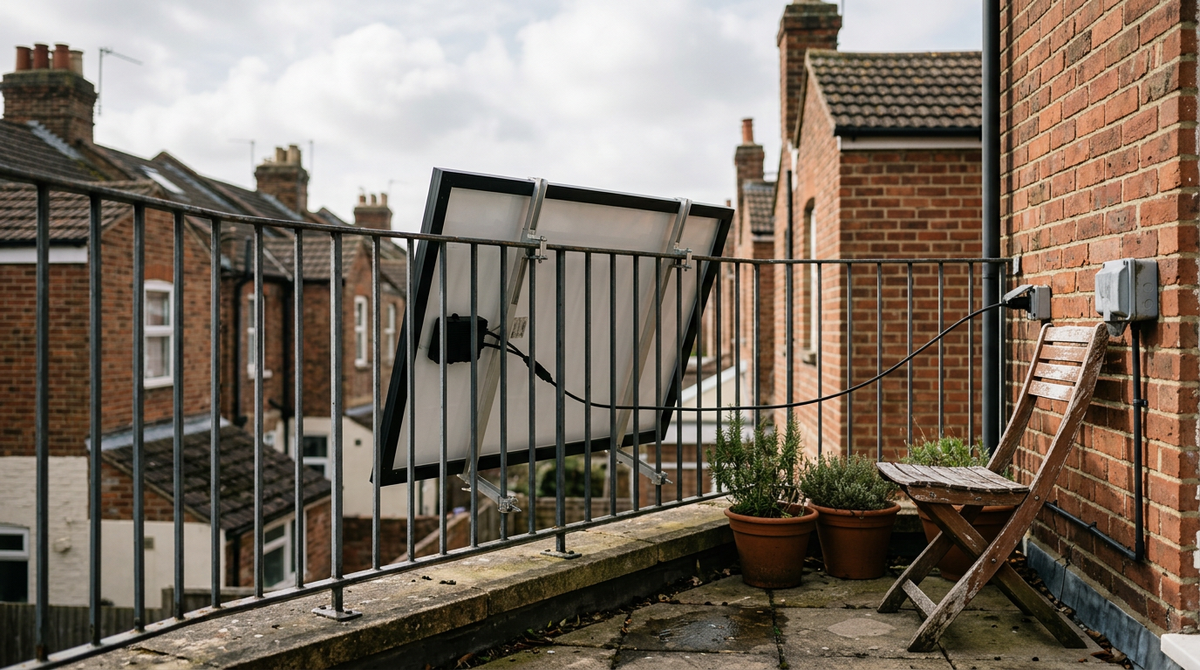
Plug-in solar panels can now be legally sold in the UK, following a government change to the rules. Retailers including Argos will stock products from Thursday, and the government expects other shops to follow.
The kits are significantly cheaper than roof-mounted systems and can be installed without an electrician. They are suited to properties with outdoor space, including some balconies.
The government hopes the products will help households cut bills and reduce reliance on overseas fuel, the price of which has fluctuated in recent months because of the Middle East conflict.
Pricing and savings
UK solar company UKSOL says a one-panel kit will cost £699 and a two-panel kit £1,089. The government expects prices to settle at £400-£600 as competition increases and more products are developed.
Government research indicates a household could save between £70 and £110 a year on energy bills. The actual figure will depend on panel orientation and how long the system runs, with an unshaded south-facing position best.
Because the electricity must be used as it is generated, households that consume power during daylight hours stand to benefit most. Surplus power flows back to the grid, but households are unlikely to be paid for it.
Unlike rooftop systems, plug-in panels do not need to be certified under the Microgeneration Certification Scheme (MCS). As a result, they will not normally qualify for the Smart Export Guarantee, which pays households for excess solar power.
Current rules allow only one device per property, although this may change in future. A single device can include more than one panel.
Output capped at 800W
The modest output is deliberate and set for safety reasons. Kits may include panels capable of generating more, but the microinverter, which converts the panel's direct current into usable household electricity, limits output to the home to 800 watts.
That is enough to cover always-on appliances such as fridges and devices on standby. The government says it should supply about a fifth of an average household's electricity use while the sun is shining.
Higher-demand appliances, such as a 3kW kettle, would draw on a combination of the panel's 800 watts and the national grid. British Gas said plug-in panels will not power a home on their own but can "meaningfully reduce how much electricity you need to buy during the daytime".
Safety and compliance
Government tests found sample systems could operate with no unacceptable heating or unsafe energy flows.
Each device has a microinverter that continuously monitors the grid connection. If power is lost, for example in an outage, or if the panel is unplugged, the unit shuts down within milliseconds so it cannot feed live electricity into dead wiring.
To be sold legally in Great Britain, new panels must be tested against the industry's G98 standard and the government's product specification. Compliant products appear on the Energy Networks Association's public register, which buyers can check before purchase.
Buyer cautions
Consumer safety charity Electrical Safety First advises buying from established retailers or their own websites rather than third-party sellers on online marketplaces. It warned that some platforms are not currently legally responsible for the safety of goods sold through them.
The charity said the devices are not necessarily suitable for every home. Its main concern is that plug-in solar can interact with older residual current devices (RCDs), which protect against electric shock, in some home electrical systems.
It recommends that a registered electrician check the wiring before purchase, particularly in older properties or where the age and condition of the wiring is unknown.
The charity also said panels should never be connected through an extension lead, cable reel or plug-in adaptor, as these can overheat. Only one device should be connected per property, in line with the regulations and guidance developed by the Energy Saving Trust with the government.
Installation
The panels come with a mounting kit and instructions. Some tools may be needed, but professional installation is not required.
Once mounted, users connect the microinverter and plug it into a mains socket, ideally a weatherproof external one. The systems are not permanently fixed, so they can be moved to another property.
Landlord, freeholder or building owner permission may be required. Households must also inform their Distribution Network Operator (DNO) within 28 days of plugging in. The DNO is the company that owns the local cables, not the household's energy supplier. National Grid offers a postcode tool to identify the relevant operator.